Learning Ableton Live isn't as difficult as the internet makes it look, but the way most people try to learn it is wildly inefficient. After 20 years of producing electronic music and over 11,000 hours of one-to-one Ableton tuition, I've watched hundreds of students go from opening the DAW for the first time to releasing finished tracks. The ones who progress fastest all have one thing in common: they follow a structured path and they get feedback on their work. The ones who stall? They're usually stuck in a loop of watching random YouTube tutorials and wondering why nothing clicks.
This guide is the honest roadmap I wish existed when I started. No hype, no "learn Ableton in 30 days" nonsense, just a clear breakdown of what to focus on, in what order, and what to expect at each stage.
Start With the Foundations, But Make Something on Day One
Here's what I do in a first lesson with a complete beginner: we cover the Ableton Live interface, set up their audio preferences, and by the end of that 90 minutes, they've built a simple loop. Not a finished track. Not a masterpiece. A loop, maybe 1 bars of drums, a bassline, and a simple melodic element.
Why? Because you need to understand the basics of how Ableton is laid out before you can do anything meaningful. You need to know what a clip is, what a track is, how the browser works, where your sounds live. But you also need to make something immediately, because that's what keeps you coming back. If your first session is three hours of reading the manual, you'll lose motivation before you've made a single sound.
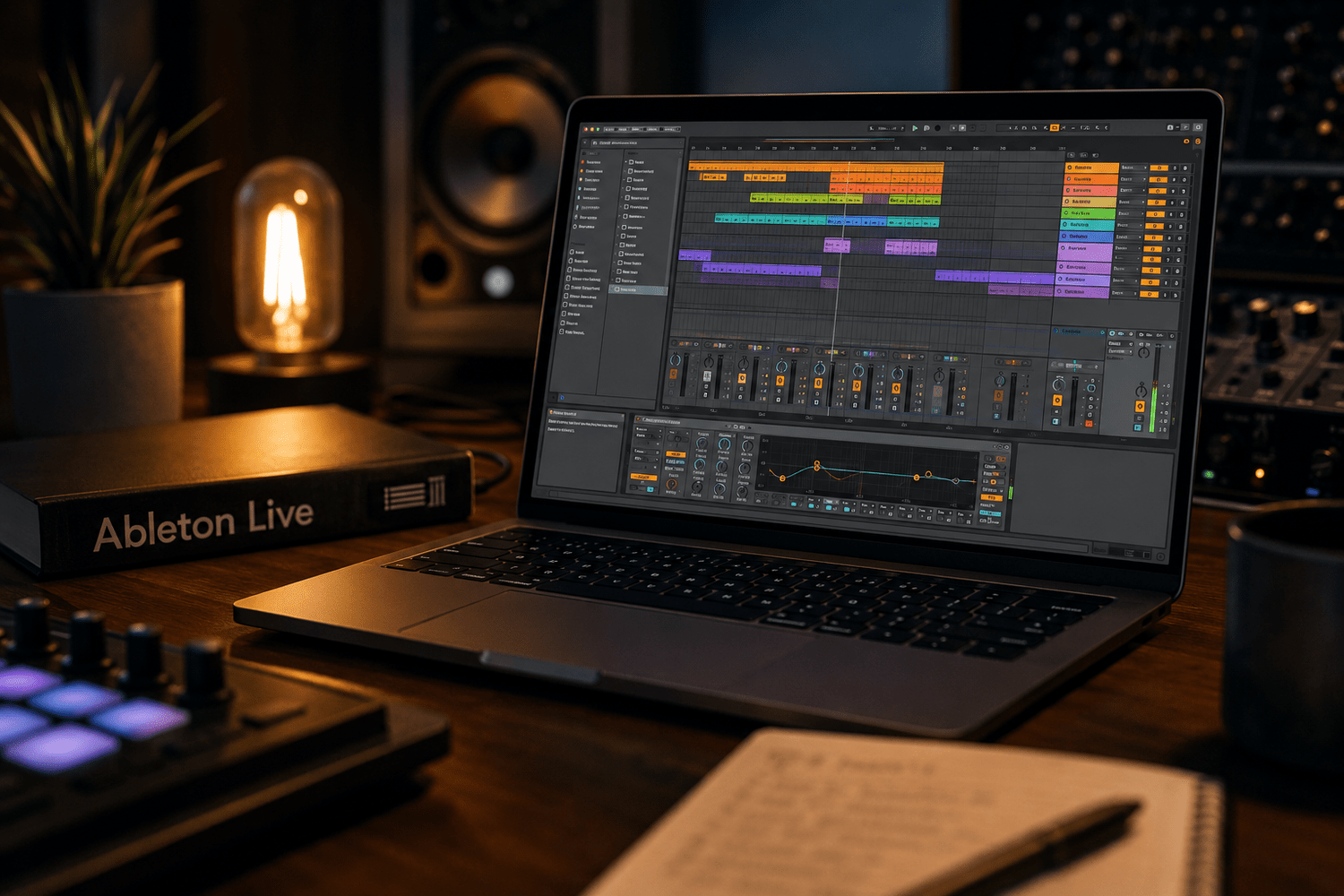
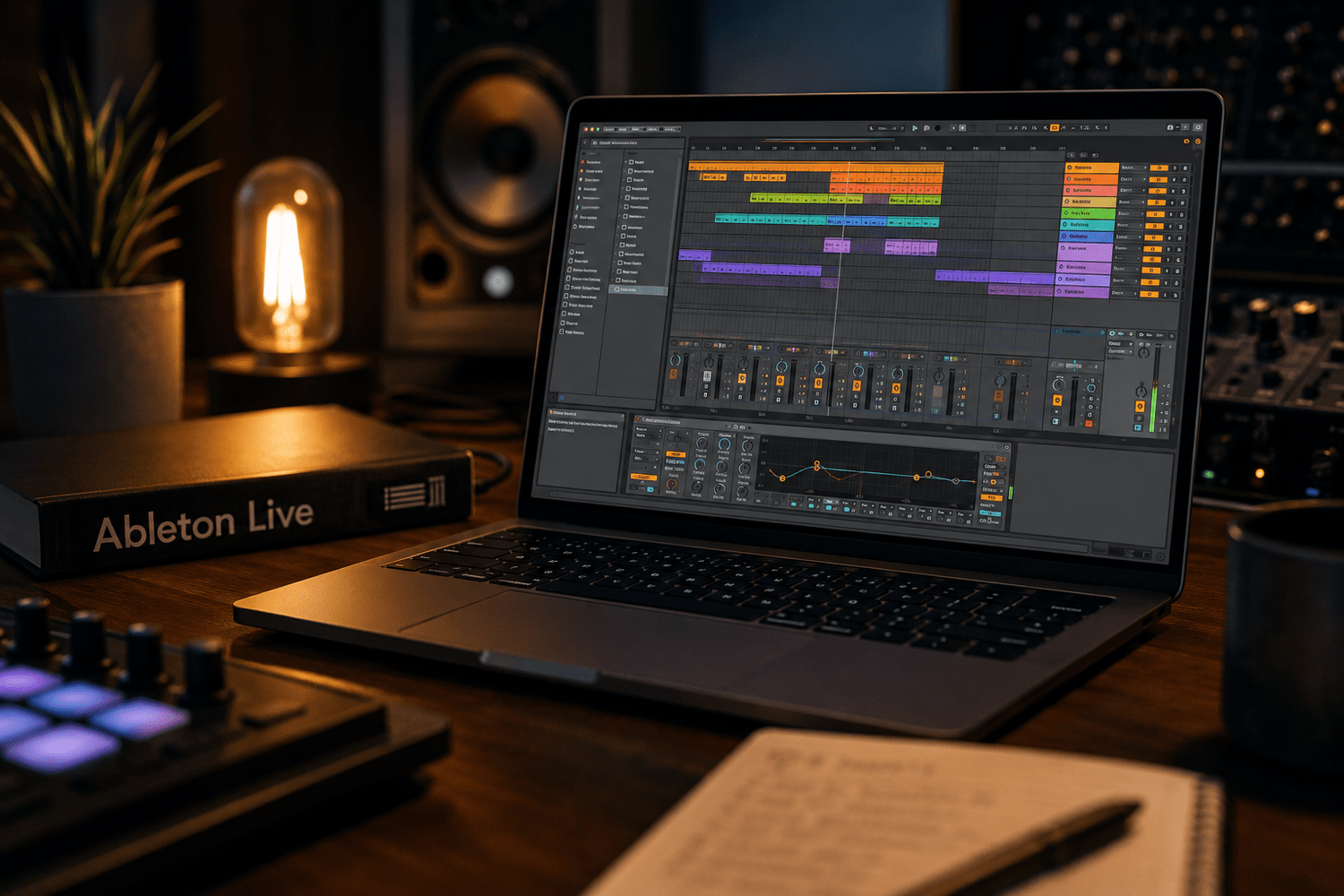
The interface can feel overwhelming at first glance. Ableton has two main views, Session View and Arrangement View, plus a browser, a detail view for devices, and a mixer. That's a lot of panels. But here's the thing: you don't need to understand all of it on day one. You need to understand enough to put sounds on a timeline and hear them play back. Everything else gets layered in as you need it.
Most online guides try to be comprehensive from the start. They'll spend 45 minutes walking you through every single menu option before you've heard a kick drum. That's backwards. Learn the interface through the process of making music, and the knowledge sticks in a way that passive watching never achieves.
Why YouTube Tutorials Aren't Enough
I need to be direct about this because it's the single biggest misconception I see: watching YouTube tutorials is not the same as learning Ableton Live.
Don't get me wrong, there's brilliant content on YouTube. Channels covering sound design, mixing, arrangement, creative techniques. I'm not dismissing any of that. But there are two fundamental problems with relying on tutorials as your primary learning method.
First, there's no feedback loop. You can follow a tutorial step by step, recreate exactly what the creator did, and end up with something that sounds decent. But the moment you try to apply that technique to your own music, with your own sounds and context, it falls apart, and you have no idea why. A tutorial can show you what to do. It cannot tell you why your version doesn't sound right. That gap between following instructions and actually understanding what you're doing is enormous, and it only gets filled through feedback from someone who can hear what you're hearing and diagnose the problem.
Second, there's no structure. YouTube's algorithm doesn't care about your learning path. It cares about watch time. So you end up bouncing from a video on sidechain compression to one on Wavetable synthesis to one on mastering, with no logical progression. You accumulate fragments of knowledge with massive gaps between them. You might know three ways to make a supersaw but have no idea how to EQ a kick drum. That scattered, Swiss-cheese knowledge base is one of the most common things I see in students who come to me after months or even years of self-teaching.
Tutorials have their place. They're great for inspiration, for discovering techniques you didn't know existed, for solving a specific problem when you already have a strong foundation. I have a YouTube channel myself, but I deliberately gear that content towards intermediate and advanced producers rather than beginners, because I know that beginner-level learning is best done with structure and feedback, not by passively watching videos. But as a primary learning method for someone starting out? Tutorials alone are the slow road.
The Stages of Learning Ableton (As I've Seen Them Over 15 years of teaching)
I don't use a rigid, one-size-fits-all curriculum. Every student I work with gets a path tailored to their goals, their genre interests, and their current level. Someone who wants to make techno has a different journey from someone producing ambient music or hip-hop beats. That said, after teaching this many hours, I've noticed that students tend to move through recognisable stages, even if the specifics differ.
Stage 1: Getting Comfortable
This is where you learn to navigate the DAW without it feeling like a foreign language. You understand clips, tracks, the browser, basic audio and MIDI concepts. You can drag in samples, draw in MIDI notes, use a few effects. You can build a loop and it doesn't feel like a battle.
For most people, this takes somewhere between 2 and 6 weeks of regular practice, maybe 3 to 5 hours a week. If you're working with a tutor, you can compress this significantly because you skip the hours of Googling "why is there no sound coming out" (it's almost always the audio preferences or the monitoring settings, by the way).
Stage 2: Building Ideas
Now you can put sounds together without fighting the software. This is where the creative work really begins. You're building loops, experimenting with different sounds, starting to develop an ear for what works. You might not be finishing tracks yet, and that's completely fine. You're learning to generate ideas.
This is also where most people hit their first real wall: the 8-bar loop trap. You make something that sounds good, 8 bars of drums, bass, maybe a pad, and then you have no idea how to turn it into a full track. This is normal. Arrangement is a skill that takes time to develop, and it's one of the hardest things in music production because it requires you to think about time, energy, tension, and release in ways that loop-making doesn't.
Stage 3: Finishing Music
The jump from "I can make cool loops" to "I can finish a track" is where most self-taught producers get stuck, sometimes for years. It involves arrangement (structuring your ideas over time), basic mixing (making your elements sit together and sound clear), and the discipline to call something done.
This stage is also where tailored guidance makes the biggest difference. The specific challenges you face in finishing a techno track are different from finishing a house track or a drum and bass track. Genre conventions, energy curves, arrangement structures, these all vary, and having someone who understands your target genre and can point you in the right direction saves an enormous amount of time.
Stage 4: Refining Your Craft
This is open-ended and, truthfully, never really ends. You're finishing tracks, but now you want them to sound better. You dig deeper into mixing, maybe start learning mastering. You develop your own sound design techniques. You get more efficient with your workflow. You start to develop a personal style.
Some students reach this stage in 6 months. Others take a couple of years. The timeline depends entirely on how much time you put in, what your goals are, and whether you're getting quality feedback along the way.
What to Focus On First (And What to Ignore)
If you're just starting out with Ableton Live in 2026, here's what I'd prioritise, and what I'd deliberately leave for later.
Focus on now:
The Ableton interface and navigation. Learn Session View and Arrangement View. Understand clips, tracks, scenes. Get comfortable with the browser. Learn the key shortcuts, Cmd/Ctrl+D to duplicate, Tab to switch views, 0 to deactivate clips. These basics will speed up everything that follows.
Making beats with samples. Before you touch a synthesiser, learn to work with audio samples. Drag drum samples onto an audio track or into Drum Rack. Build a simple beat. This teaches you the fundamentals of rhythm, timing, and arrangement without the complexity of synthesis.
Basic MIDI. Learn to draw MIDI notes, use a simple instrument (try a preset in Drift or Simpler), and understand velocity. MIDI is how you'll write melodies, chords, and basslines, so get comfortable with the MIDI editor early.
Simple effects. EQ Eight, Compressor, Reverb, Delay. You don't need to master these yet, just understand what they do at a basic level. "EQ shapes the tone, compression controls dynamics, reverb adds space, delay adds rhythm." That's enough to start.
Leave for later:
Advanced sound design. Wavetable, Operator, and FM synthesis are deep topics. They're rewarding, but they'll slow you down if you dive in before you can comfortably build and arrange a track.
Mastering. You don't need to think about mastering until you're consistently finishing mixes. Worrying about LUFS and limiting when you can't arrange a track is putting the cart miles before the horse.
Third-party plugins. Ableton's stock devices are phenomenally powerful. I've been teaching with them for years and they cover the vast majority of what you'll need. Resist the urge to buy plugins to solve problems that are actually skill gaps - every additional shiney new toy you buy extends your learning curve.
How Long Does It Take to Learn Ableton Live?
This is one of the most common questions I get, and the honest answer is: it depends entirely on what "learn" means to you. I go in to depth on this subject in another article here, where I explain there are many layers to learning music production.
If "learn" means you can open Ableton and build a basic beat? A few weeks of focused practice.
If "learn" means you can produce a finished track that sounds decent? Typically 6 to 12 months of regular work, assuming you're practising several hours a week and getting some form of structured guidance.
If "learn" means you're producing at a level where your tracks can compete on labels? That's usually a multi-year journey. There are no shortcuts here. The musicians and producers who make it look easy have thousands of hours behind them.
The most important factor isn't talent, it's consistency. Thirty minutes a day will get you further than a marathon session once a fortnight. Your brain needs regular repetition to internalise workflows, develop muscle memory with the software, and build your ear.
The Best Way to Learn Ableton Live in 2026
You have more options than ever: YouTube, online courses (Coursera, Udemy, Skillshare), Ableton's own learning resources, forums, Discord communities, and one-to-one tuition.
Here's my honest take on how to combine them effectively:
Use Ableton's built-in resources, Learning Music (learningmusic.ableton.com) and Learning Synths (learningsynths.ableton.com) are genuinely excellent, interactive, and free. Start there.
Pick one structured course or tutor and stick with it. The biggest mistake is jumping between five different YouTube channels and three courses simultaneously. Pick one path and follow it through. Depth beats breadth, especially at the beginning.
Practice with intention. Don't just noodle. Set a goal for each session: "Today I'm going to build a 4-bar drum pattern and add a bassline." Small, specific goals keep you progressing.
Get feedback on your work. This is the accelerator that most self-learners miss entirely. Whether it's a tutor, a production buddy, or a community that gives honest critiques, someone needs to hear your work and tell you what's working and what isn't.
Make music you actually want to listen to. If you love techno, learn to make techno. If you love ambient, make ambient. Motivation is everything in the early stages, and nothing kills motivation faster than forcing yourself to make music you don't care about.
Frequently Asked Questions
Can I learn Ableton Live for free?
Yes, to a point. Ableton's own Learning Music and Learning Synths tools are free and excellent for fundamentals. YouTube has thousands of tutorials. But free resources lack structure and personalised feedback, which is where most self-learners plateau. Think of free resources as a starting point, not the entire journey.
Do I need to know music theory to use Ableton?
No. Ableton Live 12's scale mode lets you lock your notes to a key, so you can write melodies and chords without formal theory knowledge. That said, understanding basic concepts like keys, chords, and song structure will make you a better producer over time. You don't need to learn it first, learn it alongside your production skills.
Is Ableton Live better than FL Studio for beginners?
Both are excellent DAWs. Ableton tends to suit people interested in electronic music, live performance, and experimental workflows because of its Session View and real-time capabilities. FL Studio has a more visual pattern-based workflow that some beginners find intuitive. The best DAW is the one you enjoy using. If you're reading this blog, you're probably already leaning towards Ableton, and it's a fantastic choice.
How many hours a week should I practise?
Consistency matters more than marathon sessions. Three to five hours a week, spread across several shorter sessions, is a solid starting point. Even 30 minutes a day will compound into real progress over months. The key is regularity. Your brain consolidates skills between sessions, so daily short practice beats weekly long sessions.
Should I buy Ableton Live Intro, Standard, or Suite?
Start with Intro or Standard. Suite is powerful but overwhelming for beginners, you don't need Wavetable, Operator, and Max for Live on day one. Ableton offers educational discounts and upgrade pricing, so you can start smaller and move up when you've outgrown your current version. I cover this in detail in my Intro vs Standard vs Suite comparison.
Ready to Fast-Track Your Progress?
If you're tired of scattered YouTube tutorials and want a clear, structured path tailored to your goals, that's exactly what I do. I've delivered over 11,000 hours of one-to-one Ableton Live tuition since 2014, working with complete beginners through to advanced producers.
Every lesson is 90 minutes, fully personalised, and recorded so you can rewatch anytime. Whether you want to learn Ableton from scratch, finish your first track, or level up your mixing, we'll build a plan around where you are and where you want to be.